
A real lesson · no account needed
The Norman Conquest and Claimants to the Throne
An interactive Key Stage 3 lesson exploring the succession crisis of 1066, the three claimants to the English throne, and the decisive Battle of Hastings.
Year 7 · History · 15 slides. This is a complete lesson built in Classfolio by a practising teacher, shown here exactly as it was written.
Slide 1 · Interactive activity
Interactive activitytext only1066 Succession Crisis Vocabulary Retrieval
Let's review the key terms we need to understand the crisis of 1066. Find the four crucial vocabulary words in the word search grid that relate to the battle for the English throne.
Interactive activity1 mark1066 Succession Crisis Vocabulary Retrieval
Find the key historical vocabulary words hidden in the grid using the clues provided.
Word SearchPrintable + live1066 Key Vocabulary Search
Locate the four key historical terms in the word search grid that match the clues.
HGWSCUPCGJPUQSRLWHVCUUNAITOCVRBITDAEOPPMASWSCESANJKSHRHNUTTOGECTVSKRKCHRsuccessorclaimantwitanusurperSlide 2 · Explanation
Explanation slideimage rightThe Crisis of 1066
On 5 January 1066, King Edward the Confessor died. He left no children or clear heir to the English throne, triggering a massive succession crisis. England was a wealthy, powerful kingdom, and control over it was highly desirable. Three powerful men believed they had the rightful claim to succeed him, setting the stage for a year of conflict and invasion.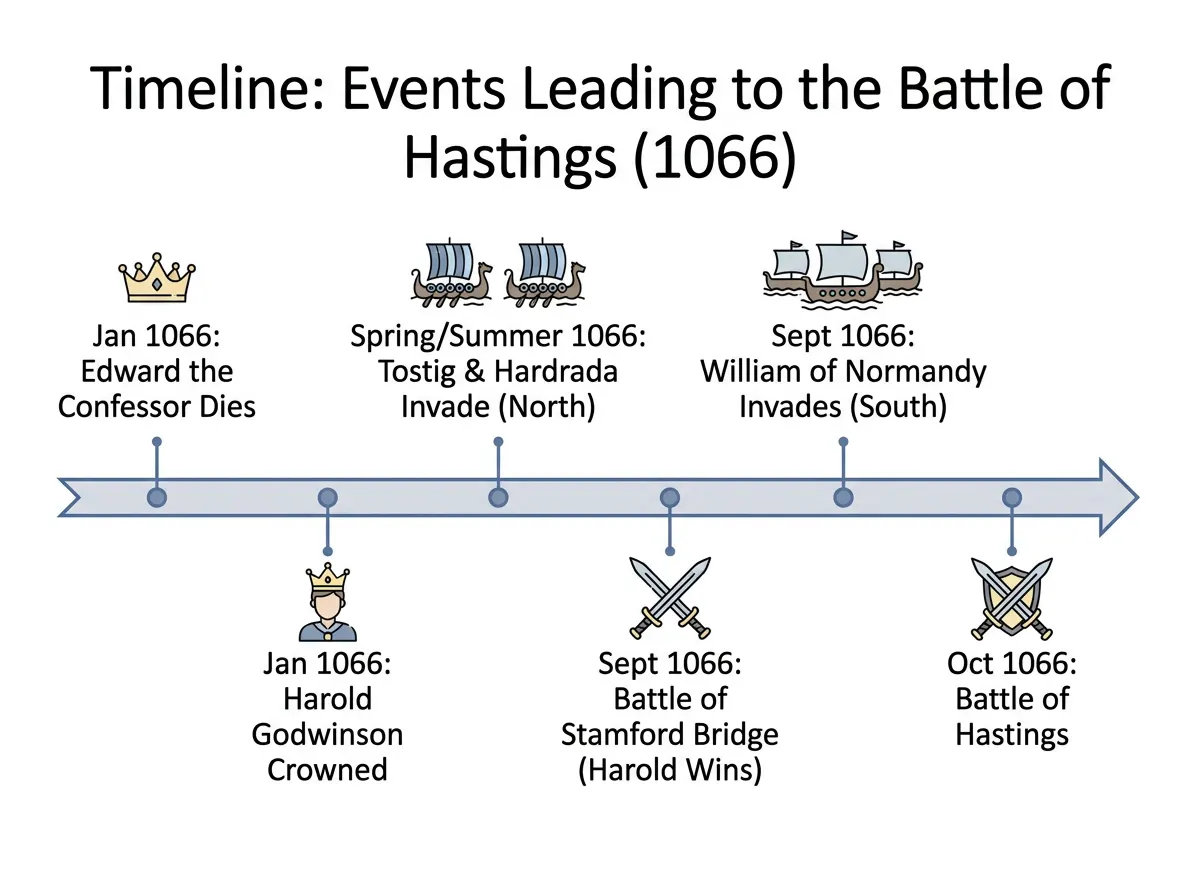
Slide 3 · Discussion
Oracy Activitytext onlyEvaluating the Three Claimants
Before the battles began, the English council of nobles (the Witenagemot) had to choose the next king. Let's look at the three main men who claimed the throne: Harold Godwinson: The richest nobleman in England, chosen by the Witenagemot.William, Duke of Normandy: A distant cousin of Edward, who claimed Edward had promised him the throne.Harald Hardrada: The fierce Viking King of Norway, who claimed an old agreement gave him the throne.Oracy ActivityEvaluating the Three Claimants
Who had the strongest claim to the English throne in 1066?
Slide 4 · Drag & drop
Drag & Droptext onlyCategorise the Claimants' Arguments
No slide content yet.
Drag & Drop6 marksCategorise the Claimants' Arguments
To understand the crisis, we must look closely at why each man believed the crown was theirs. Sort the arguments on the left into the correct claimant's column.
Slide 5 · Multiple choice
Multiple choicetext onlyCheck Your Knowledge: The Witenagemot
Let's review the role of the English ruling council during this crisis.
Multiple choice1 markCheck Your Knowledge: The Witenagemot
What was the Witenagemot, and what role did they play in January 1066?
AA French army that invaded the south of England.BThe council of English nobles who elected Harold Godwinson as king.CA holy treaty signed between William of Normandy and the Pope.DThe personal bodyguard of King Edward the Confessor.Slide 6 · Explanation
Explanation slideimage leftThe Threat of Invasion
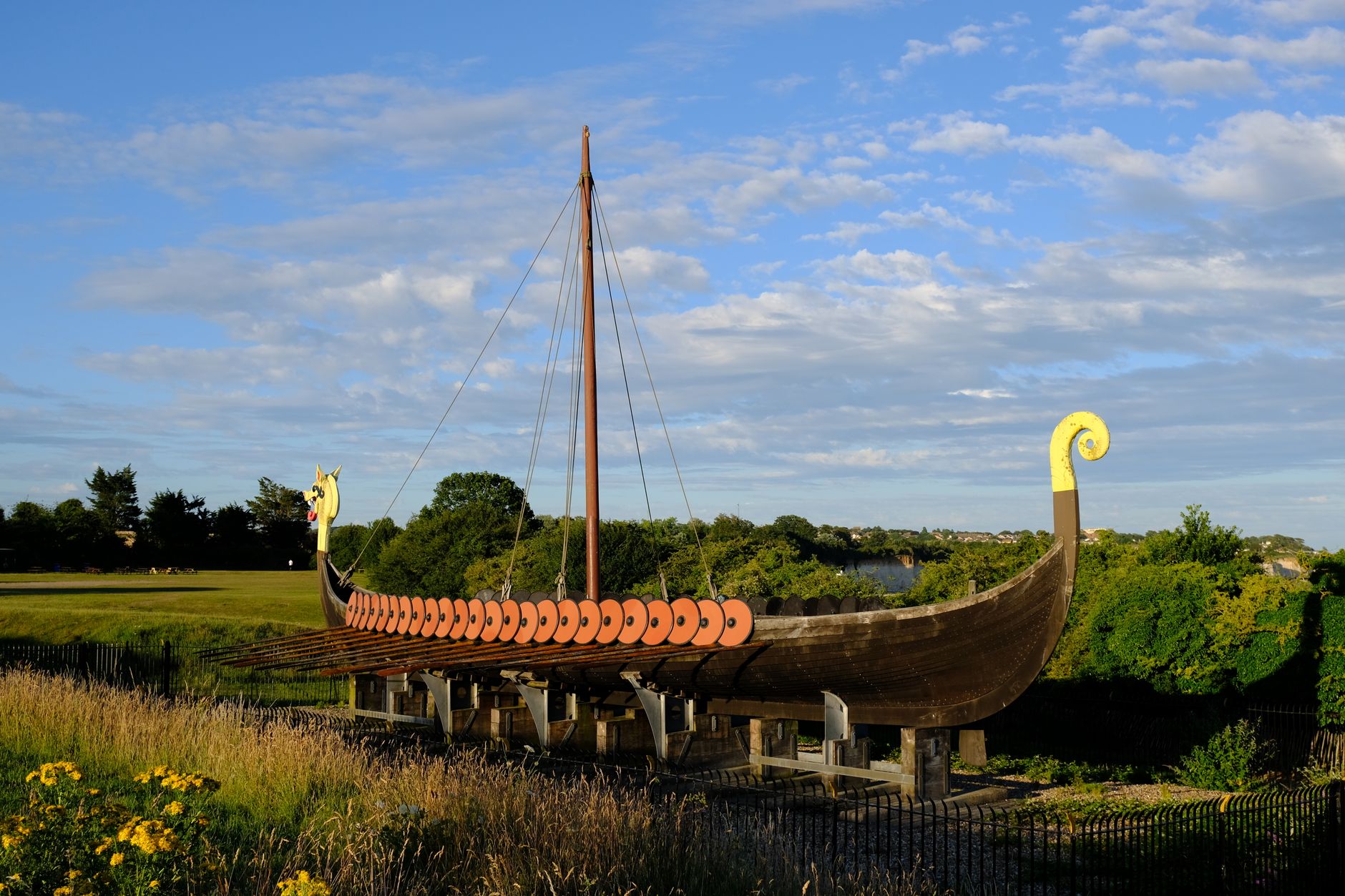
Photo by Jonathan Plumridge on Pexels
Harold Godwinson was crowned King of England, but his rivals did not accept this. England faced a double invasion in September 1066: In the North: Harald Hardrada invaded Yorkshire with 300 Viking ships. King Harold marched north and defeated him at the Battle of Stamford Bridge.In the South: Meanwhile, William of Normandy landed his fleet on the south coast, completely unopposed because Harold's army was in the north. King Harold had to march his exhausted army 250 miles back south to face William.Slide 7 · Interactive activity
Interactive activitytext onlyInteractive activity
No slide content yet.
Interactive activity3 marksInteractive activity
Complete the vocabulary retrieval activity.
Diagram LabellingPrintableLabel the diagram
Match each label to the correct hotspot on the diagram.
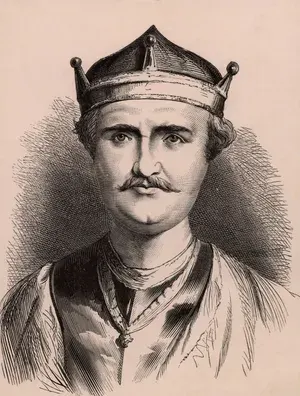 CrownNecklaceNose
Slide 8 · Explanation
Explanation slidetext onlyBefore you start: Chronology of 1066
Death of Edward the Confessor (Jan 1066) — Edward dies without an heir, leaving the throne empty. Coronation of Harold Godwinson (Jan 1066) — The Witenagemot crowns Harold as the new King of England. Battle of Stamford Bridge (Sep 1066) — Harold defeats the Viking invasion led by Harald Hardrada in the north. William of Normandy Lands (Sep 1066) — Norman forces land unopposed at Pevensey on the south coast. Battle of Hastings (Oct 1066) — William's Norman army defeats King Harold, who is killed in battle.
Slide 9 · Interactive activity
Interactive activitytext onlyChronology of 1066
No slide content yet.
Interactive activity1 markChronology of 1066
Order the key events of the Norman Conquest in the correct sequence to trace how the succession crisis unfolded.
Timeline BuilderPrintableThe Timeline of 1066
Place the events of 1066 in the correct chronological order.
1Jan 1066 — Death of Edward the Confessor2Jan 1066 — Coronation of Harold Godwinson3Oct 1066 — Battle of Hastings4Sep 1066 — Battle of Stamford BridgeSlide 10 · Explanation
Explanation slideimage rightThe Battle of Hastings
On 14 October 1066, the two armies met near Hastings. The Saxon Shield Wall: King Harold's infantry formed a dense defensive wall at the top of Senlac Hill. The Normans could not break through.The Feigned Retreat: Rumours spread that William was killed. Some Normans retreated, and Saxon soldiers broke formation to chase them. William revealed his face and ordered his cavalry to cut down the isolated Saxons.The Turning Point: The shield wall was weakened. Harold was killed (by an arrow to the eye, or hacked down), and the Saxon army fled.
Photo by Necati Ömer Karpuzoğlu on Pexels
Slide 11 · Interactive activity
Interactive activitytext onlyKey Vocabulary Match
No slide content yet.
Interactive activity1 markKey Vocabulary Match
Test your memory of the key terms we have used to describe the events of 1066.
Keyword MatchPrintableNorman Conquest Vocabulary
Match each key historical term to its correct definition.
Succession Crisis
A political struggle that happens when a country has no clear heir to the throne.
Claimant
A person who asserts that they have a right to become the ruler.
Witenagemot
The council of Anglo-Saxon nobles who elected the king.
Feigned Retreat
A military tactic where soldiers pretend to run away to lure the enemy out of position.
Slide 12 · Discussion
Oracy Activitytext onlyWriting Preparation: Why did William Win?
To write a strong explanation of the Battle of Hastings, we must rehearse our arguments. Consider the reasons for William's victory: The Saxon army was exhausted from marching 250 miles.William used highly trained cavalry and archers; Harold relied on infantry.The Saxon soldiers broke their shield wall during the feigned retreat.
Oracy ActivityWriting Preparation: Why did William Win?
Explain why William of Normandy won the Battle of Hastings.
Slide 13 · external resource
External Resourcetext onlyExplore the Bayeux Tapestry
The Bayeux Tapestry is our most famous source of evidence for the Battle of Hastings. It was made shortly after the conquest to tell the story from the Norman perspective. Look at how it depicts the key moments, including the death of Harold and the Norman cavalry charges.Slide 14 · Multiple choice
Multiple choicetext onlyCheck Your Understanding: Battle Tactics
Let's review the critical moment that decided the outcome of the Battle of Hastings.
Multiple choice1 markCheck Your Understanding: Battle Tactics
Which tactic did the Normans use to break the Saxon shield wall at Hastings?
AA surprise night attack before the battle began.BA feigned retreat to trick the Saxons into breaking their line.CDigging tunnels under the Saxon positions on the hill.DUsing longships to attack the Saxons from behind.Slide 15 · exit ticket
Exit tickettext onlyThe Coronation and the Legacy of 1066
Following his victory, William marched on London. He was crowned King of England at Westminster Abbey on Christmas Day 1066, ending Anglo-Saxon rule and beginning the Norman era. This completely changed England's language, laws, and architecture.Exit ticket2 marksThe Coronation and the Legacy of 1066
Summarise the main cause and the final outcome of the 1066 succession crisis in three sentences.
In Classfolio, this lesson is live
Pupils answer on their own devices, responses appear on the board as they arrive, and written answers can be marked by AI with the teacher reviewing every mark. What you see above is the plan; the lesson itself is interactive.